


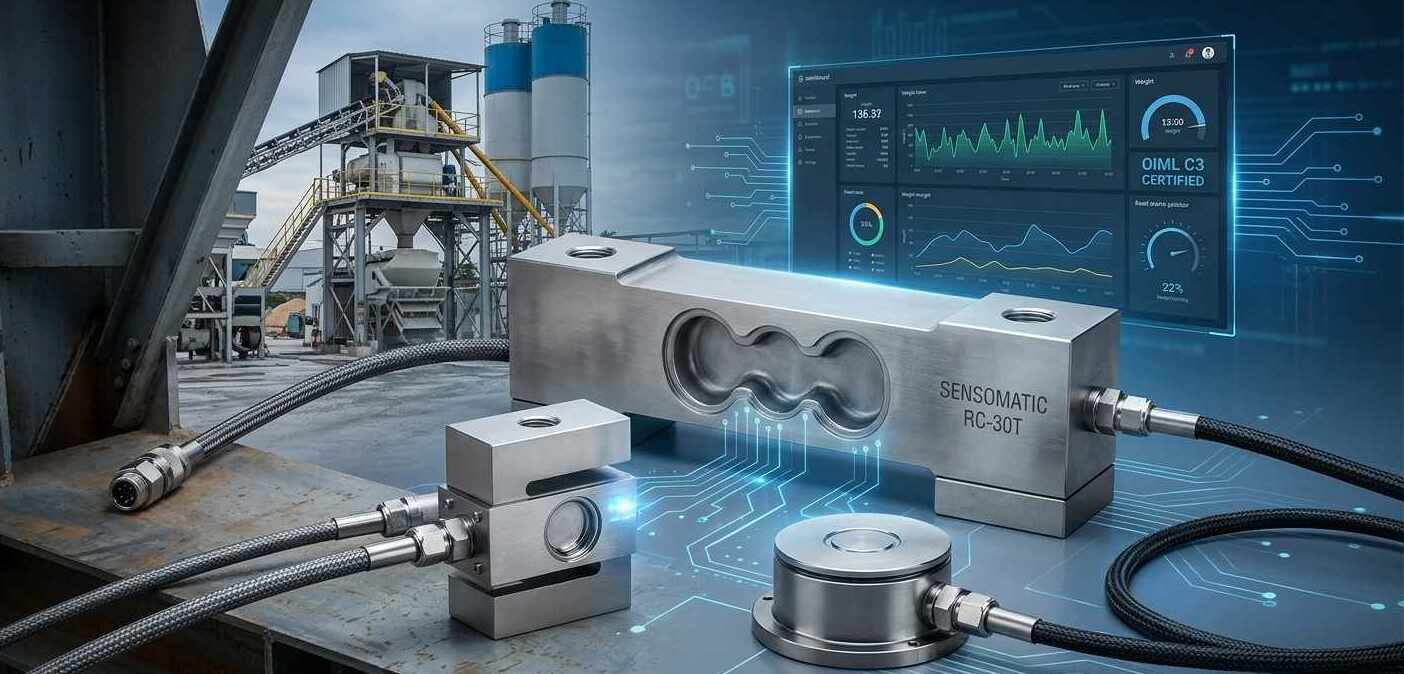
Why Load Cells Accuracy Matters in Industrial Applications
A pharmaceutical plant in Pune was producing injectable drug solutions. Their dosing system was off by 0.8%. That fraction of a percentage, invisible on paper, translated to 4,800 underdosed vials before anyone caught the problem. The root cause? A worn-out load cells that nobody had recalibrated in 14 months.
That is not a horror story. That is Tuesday for process engineers who underestimate what these sensors actually do.
In industrial automation, a load cells is not just a weighing instrument. It is the nervous system of your entire process. Get it right, and your batching system, filling line, or weighbridge runs with machine-like precision. Get it wrong, and the errors compound quietly until they become expensive, sometimes dangerous.
According to GrowthMarketReports, the global load cells market was valued at $2.35 billion in 2024 and is growing at 4.8% CAGR through 2033. Industries are not buying more of these sensors because they are trendy. They are buying them because every precision-dependent process depends on reliable force measurement at its core.
What is a Load Cells?
A load cells is a force transducer that converts a mechanical force (compression, tension, or shear) into a proportional electrical signal, typically measured in millivolts per volt (mV/V). You apply a physical load, the sensor deforms microscopically, and an electrical circuit translates that deformation into a readable measurement.
Think of it this way. When you stand on a bathroom scale, something inside has to “feel” your weight and turn it into a digital readout. That something is a load cells. The same principle governs a 100-tonne truck crossing a weighbridge and a 0.5g capsule being filled on a pharmaceutical line. Same physics. Wildly different scale.
Most modern load cells use strain gauges, which are thin foil resistors arranged in a zig-zag pattern and bonded to a metal body. When force is applied, the metal flexes, the gauges stretch or compress, and their electrical resistance changes in direct proportion to the applied load. Signal conditioning electronics then amplify that resistance change into a usable output.
Load Cells Working: How Does It Actually Function?
Understanding load cells working helps you troubleshoot faster and specify better. Here is the full load cells signal chain, without the textbook language.
- Step 1: Apply the Load.Force is applied to the spring element, which is the machined metal body. This can be compression (pushing), tension (pulling), or shear (lateral). The geometry of the spring element determines which force directions the sensor reads accurately.
- Step 2: The Body Deforms.The metal element deflects elastically, meaning it bends but returns to its original shape when the load is removed. This deformation is measured in microstrains (millionths of a unit of strain). It is invisible to the naked eye. The sensor detects it without difficulty.
- Step 3: Strain Gauges Respond.Four strain gauges bonded to the spring element change resistance in proportion to the deformation. Two gauges experience tension; two experience compression. They are arranged in a Wheatstone bridge configuration that cancels out temperature-induced errors and doubles measurement sensitivity. This is why strain gauge sensors deliver accuracy within 03% to 0.25% of full scale in real industrial conditions.
- Step 4: Signal Conversion.The bridge imbalance, typically 1 to 3 mV/V, feeds into a signal conditioner or digital indicator. That device amplifies, filters, and converts the raw signal into weight readings, 4 to 20 mA analog outputs, or digital protocols such as Modbus, CANbus, or Profibus for Industry 4.0 integration.
- Step 5: Control Action. The processed signal drives a display, PLC, batch controller, or IoT cloud dashboard. In 2025, 63% of new industrial deployments use IoT-enabled load measurement systems, meaning the output is not just a number on a screen but a live data feed for predictive maintenance and process analytics.
Types of Load Cells Explained
Selecting the right type from the available types of load cells is more consequential than brand or price. The geometry, mounting method, and force direction must align with your application before any other specification matters. Here are the four types most relevant to industrial weighing.
S-Type Load Cells (S-Beam)
The S-type sensor is named for its distinctive S-shaped profile, which allows it to measure both tension and compression along a single axis simultaneously. The strain gauges are bonded to the central web of the S, where shear stress is highest, giving it a characteristic bidirectional capability.
Capacity range: 5 kg to 5,000 kg Typical accuracy: plus or minus 0.03% to plus or minus 0.1% of full scale Body material: Alloy steel or stainless steel Output: 2 to 3 mV/V at rated capacity
S-type cells are compact and straightforward to install in both tension and compression orientations, which makes them the dominant choice wherever loads hang or pull. The symmetric design also provides excellent resistance to side-loading, which protects accuracy when the applied force drifts slightly off-axis during dynamic weighing cycles.
When to use: Choose an S-type sensor when your load hangs rather than sits: hopper and tank weighing in tension, overhead crane load monitoring, tensile testing rigs, and retrofit conversions of mechanical platform scales. It is also the right choice wherever a single mounting point must measure force in both pull and push directions without swapping hardware. One practical note: always install with threaded rod ends and check cables to prevent the sensor from rotating under torque, which introduces nonlinearity error that is easy to miss during commissioning but impossible to calibrate away.
Shear Beam Load Cells
The shear beam is the most widely deployed industrial load cells in global manufacturing. It is a rectangular alloy or stainless steel block with strain gauges placed at 45 degrees to the loading axis, directly at the point of maximum shear stress. This geometry gives the shear beam its defining advantage: superior resistance to off-axis loads, bending moments, and eccentric loading, all of which are common in real platform weighing environments.
- Capacity range:50 kg to 50,000 kg.
- Typical accuracy:plus or minus 0.02% to plus or minus 0.05% of full scale.
- IP rating:IP67 to IP68 standard on most load cells models; IP69K available for wash-down.
- Body material:Nickel-plated carbon steel or stainless steel for corrosive environments
Because the mounting points are fixed at both ends of the beam, the shear beam is less sensitive to load eccentricity than bending beam designs. This makes multi-cell tank and platform applications more stable. Shear beam and bending beam types together held 26.2% of global load cells market share in 2024, which reflects their dominance in general industrial weighing.
When to use: Choose the shear beam for platform scales, floor scales, conveyor belt weighing, and hopper bases where the load presses down onto the sensor. It is the safest default specification for harsh outdoor or wet environments precisely because hermetically sealed, nickel-plated, and full stainless-steel variants are all widely available in standard catalogue sizes. One important installation rule: always provide a rigid, flat mounting surface machined to within 0.05 mm parallelism. A shear beam mounted on a warped surface carries a permanent bending moment that looks identical to an offset load, degrading both repeatability and long-term zero stability without triggering any alarm.
Double-Ended Shear Beam Load Cells
The double-ended shear beam design solves one specific problem: moment error from off-centre loading at high capacities. Unlike a standard single-ended shear beam, this type is supported at both ends with the load applied at the centre. That geometry physically eliminates the bending moment that would otherwise distort readings when a vehicle, barge, or storage tank distributes weight unevenly across its base.
- Capacity range:500 kg to 100,000 kg and above.
- Typical accuracy:plus or minus 0.02% of full scale.
- Certifications:OIML C3 class for legal-for-trade applications; ATEX available.
- Body material:High-tensile alloy steel, nickel-plated or stainless
Multi-cell weighbridge installations use four to six of these sensors arranged under a weigh deck. Even when a 60-tonne truck stops with its front axle over one pair of cells and its rear axle over another, each sensor reports independently, and the system software sums the total with full traceability.
When to use: Specify a double-ended shear beam whenever capacity exceeds 2,000 kg and load placement cannot be guaranteed to be perfectly centred. This covers weighbridges, railway wagon scales, large silo bases, concrete batching plant hoppers, and steel ladle weighing systems.
For multi-cell tank installations, use matched sets where every sensor in the group comes from the same manufacturing batch with near-identical sensitivity values. A mismatch in rated output across a four-cell tank installation introduces a systematic weighing error at all load points, not just full scale, that no single-point calibration can correct. If your application requires Legal Metrology Act compliance in India, this type with OIML C3 certification is the standard your system integrator will specify.
Compression Load Cells (Canister / Pancake)
Compression sensors are built for one purpose: handling the highest capacities in the force measurement world while maintaining a compact, low-profile footprint that fits under vessels, structural members, or press beds without raising the supported structure significantly. The cylindrical (canister) and flat disk (pancake) variants share the same axial-compression operating principle but differ in height-to-diameter ratio.
- Capacity range:1,000 kg to 500,000 kg and beyond.
- Typical accuracy:plus or minus 0.05% to plus or minus 0.25% of full scale.
- Special options:Hermetically welded stainless steel for underwater or underground use; ATEX for oil and gas.
- Body material:Alloy steel or stainless steel, fully welded
The low-profile canister design is particularly valuable in silo and vessel installations where headroom is limited, and the cell must sit below a saddle foot. They are also widely used in structural health monitoring, where they are embedded in building foundations or bridge piers to measure long-term settlement loads over years or decades.
When to use: Choose this type for static high-load applications where tension and shear forces are absent or negligible: storage tank bases in chemical plants, silo foundations in grain and cement industries, hydraulic press force measurement, and long-term geotechnical load monitoring. Always pair with a spherical seat or self-aligning load button that allows the force to find its own vertical axis. A compression sensor loaded at even a 2-degree tilt introduces a cosine error and a lateral bending moment that, at 100-tonne capacity, can produce a measurement error of more than 60 kg, worse than a general-purpose sensor mounted correctly. For underground or submerged geotechnical installations, specify the fully welded hermetic version rather than relying on potting compound alone.
Types of Load Cells: Quick Comparison
| Type | Capacity Range | Force Direction | Accuracy (% FS) | Best Application |
| S-Type (S-Beam) | 5 kg to 5,000 kg | Tension and compression | 0.03% to 0.1% | Hanging scales, hopper tension |
| Shear Beam | 50 kg to 50,000 kg | Compression | 0.02% to 0.05% | Platform scales, conveyors |
| Double-Ended Shear Beam | 500 kg to 100,000 kg | Compression | 0.02% | Weighbridges, large silos |
| Compression (Canister) | 1,000 kg to 500,000 kg | Compression only | 0.05% to 0.25% | Vessel bases, press beds |
Not sure which type fits your process? The Sensomatic engineering team has specified load cells systems across more than 200 industrial installations in India. Get a Quote and free application review and we will recommend the exact type, capacity, and IP rating for your process within 24 hours.
Load Cell Applications Across Key Industries
Understanding the breadth of load cell applications in industry explains why this market keeps growing regardless of economic cycles. Anywhere force or weight drives a process decision, a force transducer belongs in the design.
Manufacturing and Process Automation
In automotive stamping plants, sensors mounted in press beds monitor forming forces in real time. When a forming die begins to wear, the force curve shifts before any dimensional defect appears in the finished part. This predictive signal gives maintenance teams a day or more of warning instead of discovering the problem in the final inspection. In wire and cable manufacturing, tension sensors on payoff reels control wire draw tension to within plus or minus 0.5% of setpoint, preventing both wire breaks (too much tension) and sag-induced coating defects (too little).
Tank and Vessel Weighing
Chemical and pharmaceutical plants mount three to six shear beam or canister sensors under storage vessels to measure contents gravimetrically rather than by level sensors. Gravimetric measurement is indifferent to foam, viscosity changes, or density variation, all of which cause level-based instruments to drift. A 50,000-litre solvent tank with four sensors installed at its base gives the control room a live inventory reading accurate to plus or minus 5 kg at full load. See our tank weighing system guide for installation best practices.
Concrete Batching and Aggregate Plants
Each ingredient hopper in a concrete batching plant sits on shear beam sensors. A typical ready-mix plant weighs cement, fly ash, aggregates, water, and admixtures in sequence, with each batch controlled to recipe accuracy within 0.1% by weight. A 1% error in a 2-tonne batch means 20 kg of wrong material. Multiply that by 300 batches per day and you understand why concrete producers take force sensor calibration seriously. Double-ended shear beam cells in the 500 kg to 5,000 kg range are standard for this application.
Weighbridge and Road Transport (India-Specific)
India’s road freight system operates under the Legal Metrology Act, 2009. Compliant weighbridge installations require OIML-certified sensors, typically 20 to 50-tonne double-ended shear beam cells, with mandatory periodic verification by State Weights and Measures departments. A four-lane weighbridge on a national highway aggregate supply route handles 500 to 800 truck crossings per day. Each crossing imposes a dynamic shock load on the sensors that exceeds static capacity by 30 to 50%. Safe overload ratings of 150% of rated capacity, combined with hermetically sealed construction, are minimum requirements for this duty.
Food and Beverage Processing
Filling machines on dairy lines and beverage bottling plants use high-speed sensors with response times below 5 milliseconds to weigh each container as it passes through the filling station. Washdown environments in these plants demand IP69K protection against high-pressure steam cleaning. In flour and spice milling, ATEX-certified sensors are required wherever combustible dust creates an explosion risk. Check-weigher systems on packaging lines use fast-response sensors that reject under- or over-filled packages at line speeds of 200 to 400 units per minute.
Pharmaceutical and Speciality Chemicals
The highest-accuracy load cells applications sit in pharma. Dispensing systems for potent active ingredients work at the 1 to 500 gram range, requiring sensors with accuracy classes of OIML C4 or better and temperature compensation across the full controlled environment range. Reactor vessel weighing in API synthesis tracks batch addition weights to confirm stoichiometric ratios, and the weighing system must maintain traceability to NIST or NPL standards for GMP documentation.
Crane and Hoist Load Monitoring
S-type and load pin sensors integrated into crane hooks provide real-time overload protection in steel mills, shipyards, and heavy fabrication shops. When the lifted load approaches the crane’s safe working load (SWL), the load monitoring system triggers an audible alarm and, in automated cranes, prevents further hoisting. This is a direct safety-critical application where sensor failure can result in structural collapse. For an overview of crane load monitoring specifications, refer to our industrial load cell applications page.
Key Technical Specifications: What Every Engineer Should Know
When reading a force sensor datasheet, the following parameters collectively determine whether the sensor will perform acceptably in your specific application. Most procurement decisions are made on rated capacity and a single accuracy class number. That is a shortcut that costs money at commissioning time. The parameters below are what actually govern real-world load cells measurement quality.
- Rated Capacity (RC):The maximum load the cell is designed to measure continuously. Select a cell at 70% to 80% of your maximum expected load to leave headroom for shock and dynamic loading. Operating consistently at 100% of RC accelerates fatigue and zero-point drift.
- Rated Output (RO)The electrical signal at rated capacity, expressed in mV/V. Most industrial cells output 2 mV/V or 3 mV/V with a 10V excitation supply. Higher RO improves the signal-to-noise ratio in electrically noisy environments but requires a signal conditioner with a matched input range.
- Non-Linearity:The maximum deviation of the actual output curve from a straight line drawn between zero and full-scale output, expressed as a percentage of full-scale. A non-linearity of 0.02% FS on a 1,000 kg sensor means the output curve can deviate by up to 200 grams from a perfect straight-line response at any point in the measurement range. Critically, non-linearity is a fixed property of the spring element geometry and how the strain gauges are bonded. It cannot be corrected by field calibration. A two-point calibration (zero and full scale) tells the signal conditioner where the ends of the curve sit, but does nothing to correct the bow in the middle. For batching systems weighing at mid-range most of the time, a high non-linearity value means every batch carries a systematic error that passes all end-of-range calibration checks invisibly. Precision analytical and pharmaceutical applications require non-linearity below 0.01% FS.
- Hysteresis:The difference in output between the loading and unloading curves at the same applied load. If a 500 kg load produces 2.000 mV/V when approached from below and 2.003 mV/V when the load is reduced to that same point from above, that 0.003 mV/V difference is the hysteresis error. It is caused by microscopic internal friction in the spring element material and the strain gauge adhesive bond that prevents the structure from returning to the same deformed state on each approach.
- Hysteresis matters most in bidirectional weighing cycles. A batching hopper that fills 800 kg of ingredient and then discharges fully into a mixer will, on the next fill cycle, read a slightly different zero than the previous cycle if hysteresis is significant. On a low-hysteresis cell (less than 0.02% FS), this drift is below 160 grams on an 800 kg batch. On a general-purpose cell with 0.1% FS hysteresis, the cumulative zero drift over 20 fill-and-discharge cycles can exceed 1.6 kg, which is enough to fail a pharmaceutical batch record audit.
- Repeatability:The maximum variation in output when the same load is applied multiple times in succession under identical conditions, expressed as a percentage of full-scale output. It should be below 0.01% FS for automated batching and below 0.005% FS for pharmaceutical dispensing.
- Repeatability is the most operationally important specification in automated weighing because it directly controls batch-to-batch variation. Poor non-linearity is a fixed, predictable offset that a skilled calibration engineer can partially compensate for. Poor repeatability is random: each weighing event produces a different error, and no calibration procedure can predict or remove it. A system with 0.05% FS repeatability on a 200 kg batch produces 100-gram variation between consecutive batches measured under identical conditions. In a GMP pharmaceutical environment, that variation appears in every batch record and must be investigated as an out-of-specification event. Good repeatability is the specification that separates a sensor suitable for legal-for-trade certification from one that is not.
- Combined Error:Most manufacturers publish a “combined error” figure that encompasses non-linearity, hysteresis, and repeatability in a single worst-case number. This is the specification to compare competing products. For OIML C3 classification, the combined error must not exceed 0.023% of the full-scale output.
- Safe Overload and Ultimate Overload.Safe overload (typically 150% of RC) is how much force the cell can survive without a permanent zero-point shift. Ultimate overload (typically 300% of RC) is the point of mechanical failure. Both numbers are non-negotiable specifications for crane, weighbridge, and press applications where shock loads are routine.
- IP Rating and Environmental Protection:IP67 covers immersion up to 30 minutes at 1 meter depth. IP68 handles continuous submersion. IP69K handles high-pressure steam cleaning at 80 degrees Celsius. Match the IP rating to your actual worst-case scenario, not your average operating condition. A filling machine that gets washed down once per shift needs IP69K, not IP67.
- Temperature Range and Temperature Coefficient:Standard cells operate from minus 10 to plus 40 degrees Celsius. Each degree of temperature change shifts the zero and span of the cell by a small, measurable amount known as the temperature coefficient. A typical value is 0.002% of full scale per degree Celsius. For outdoor weighbridges in India’s seasonal climate, where temperatures swing from 5 to 50 degrees Celsius, the total temperature-induced error over the full range can reach 0.18% FS if not compensated. Specify temperature-compensated sensors for any outdoor or uncontrolled-environment application. For our full calibration and environmental specification services, visit our load cell calibration services page.
How to Choose the Right Load Cells for Your Application
Most buyers ask “which type?” before answering the six questions that actually determine the correct specification. Rushing to type selection is how you end up with a technically correct sensor that still fails in service within 18 months.
Question 1: What type of force are you measuring? Compression only (press bed, tank base, platform) points to a shear beam or canister. Tension and compression (hanging hopper, crane hook, tensile tester) points to an S-type. Any application with a significant bending moment or off-centre loading above 2,000 kg points to a double-ended shear beam. Getting the force direction wrong is the single most common cause of sensor failure in new installations, because the spring element is optimised for one loading geometry and performs poorly or degrades rapidly in any other.
Question 2: What is your capacity requirement, with a realistic overload margin? Take your maximum expected process load. Add 25 to 30% for dynamic shock (vehicle axle impact, hopper discharge surge, crane swinging). Then select the next available standard capacity above that figure. A batching hopper that holds 1,200 kg maximum product should use a sensor rated to at least 1,560 kg before shock margin, so a 2,000 kg rated capacity is appropriate. Never select a cell rated exactly at your process maximum.
Question 3: What environmental stresses will the cell face? Humidity, chemical splash, immersion, washdown pressure, explosive dust or gas, vibration, and temperature extremes all require specific protective specifications. Run through the ATEX zone classification, IP rating requirement, and operating temperature range before looking at any datasheet. An under-specified cell in a harsh environment costs far more in downtime and replacement than the premium for the correct specification upfront.
Question 4: What accuracy class is genuinely required? Legal-for-trade weighing under India’s Legal Metrology Act requires OIML C3 minimum. Internal process monitoring (batching, tank inventory, press force trending) may accept general-purpose grade at a lower cost. Pharmaceutical dispensing at the gram-level quantities needs C4 or above with documented traceability. Matching accuracy class to the actual process requirement, rather than over-specifying everything to C3, reduces cost without compromising performance.
Question 5: What output interface does your control system need? Analog mV/V works with any digital weight indicator or signal conditioner with a suitable input range. A 4 to 20 mA output connects directly to a PLC analog input card. Digital protocols (Modbus RTU, CANopen, Profibus, HART) eliminate signal conversion losses and allow the sensor to communicate diagnostics, temperature, and calibration data alongside the weight value. With 52% of manufacturers now shipping IoT-enabled sensors as standard in 2025, the incremental cost of digital output has dropped significantly. If your PLC has a spare serial port, a digital interface is worth specifying. For guidance on integrating digital sensors with PLCs, see our signal conditioner and indicator guide.
Question 6: What are the physical installation constraints? Cell height, mounting thread size, cable entry direction, and the available footprint under the load point all constrain which mechanical form factor is viable. A canister cell that requires 150 mm of vertical clearance will not work in a retrofit situation with only 80 mm available. Confirm physical dimensions against a certified drawing, not a product photograph, before committing to a specification.
Load Cells Use Cases: Real Scenarios, Real Decisions
Use Case 1: Replacing an analog batch controller in a cement plant. A cement plant running five raw material hoppers decides to upgrade from a 1990s analogue batch controller to a PLC-based system with remote monitoring. The existing sensors are shear beam type, 2,000 kg, analog mV/V output. The correct approach is not to replace the cells but to retrofit Modbus-output signal conditioners to the existing sensors, add a remote IoT gateway, and connect to a cloud historian. Total cost: 30% of full replacement. Accuracy improvement: negligible, because the existing sensors were performing correctly. The right industrial load cells decision here is to keep what works and digitise the signal chain.
Use Case 2: Pharmaceutical dispensing room upgrade. A pharma manufacturer’s dispensing booth weighs active pharmaceutical ingredients at 10 to 2,000 gram quantities. The current sensor is a general-purpose bench scale that passes OIML C4 but has no temperature compensation and sits in a room that varies from 18 to 28 degrees Celsius. The temperature coefficient error across that 10-degree range is 0.02% FS, or 400 milligrams on a 2 kg reading. For a potent API with a tight dose tolerance, that is unacceptable. The correct specification is a temperature-compensated C4 load cells with a traceable calibration certificate, recalibrated every six months. The cost difference is less than 15% over the annual budget.
Use Case 3: Outdoor weighbridge in a coastal quarry. A quarry 4 km from the Konkan coast needs a 60-metre, two-lane weighbridge for aggregate trucks carrying 40 to 60-tonne gross loads. The environment combines mean annual humidity above 85%, salt air with a chloride ion concentration that destroys nickel-plated carbon steel within 18 to 24 months, and vehicles producing axle impact loads up to 150% of static weight on rough approach roads.
The correct specification is twelve double-ended shear beam sensors rated to 30,000 kg each, full 316L stainless steel construction with hermetically welded seals and laser-welded cable entries, OIML C3 certification, and IP68 protection to 2 metres immersion. The sensors are installed in a pit-mounted steel deck with self-aligning spherical seats to absorb the 0.5 to 1 mm settlement variation across the pit length. Stainless construction adds 38% to per-sensor cost compared to nickel-plated carbon steel. Against a replacement cycle of 18 to 24 months for carbon steel in this environment versus 10 to 12 years for stainless, the total cost of ownership over 10 years is 60% lower for the stainless specification. The project specifying engineer confirmed this analysis using Sensomatic’s total cost of ownership calculator, available on our industrial load cell applications page.
Why Engineers Choose Sensomatic for Load Cells Systems
Sensomatic has engineered and supplied precision weighing and force measurement systems across Indian and international industries for over two decades. Our installations span more than 600 projects across cement, pharma, food processing, chemical, steel, logistics, and infrastructure sectors. Every one of those projects started with an application engineering review, not a catalogue lookup.
- What sets us apart from a catalogue supplier:Our engineering team reviews force type, capacity, environment, accuracy class, signal interface, and installation geometry on every inquiry before a part number is mentioned. We maintain documented application history across all major Indian process industries, which means when you describe your process, we have almost certainly solved a similar problem before. We back every recommendation with a written application review, not a verbal suggestion.
- Industries served:Concrete batching plants, chemical storage tank farms, weighbridge installations, automated filling lines, crane overload protection, hopper and silo weighing, pharmaceutical dispensing rooms, and industrial press monitoring.
- Product range:IP67 to IP69K shear beam cells, OIML C3 and C4 certified S-type sensors, hermetically sealed compression canisters for marine and underground use, ATEX-certified cells for Zone 1 and Zone 2 hazardous areas, and IoT-enabled digital sensors with Modbus and CANopen outputs.
- Custom engineering:Non-standard capacities, special thread and flange configurations, integrated temperature compensation for extreme climates, and multi-cell system design with matched sensor sets for minimum sum error.
- Post-installation support:On-site calibration using NABL-accredited reference equipment, periodic verification for Legal Metrology compliance, predictive replacement programs based on fatigue cycle tracking, and remote diagnostics for IoT-connected installations.
- Ready to specify the right load cell for your process?Our engineers respond to technical inquiries within 24 hours. Contact Sensomatic for an application review and quotation.
Frequently Asked Questions About Load Cells
What is load cells accuracy, and how is it measured?
Load cells accuracy is expressed as a percentage of full-scale output and combines non-linearity, hysteresis, and repeatability into a single combined error figure. For the OIML C3 class, combined error must not exceed 0.023% FS. Practical accuracy in a real installation also depends on cable quality, signal conditioner resolution, temperature stability, and mounting integrity. A C3 cell installed with misaligned mounting hardware will not perform to its certified specification.
What is the difference between hysteresis and repeatability?
Hysteresis is the error caused by the direction of loading: the reading when approaching a weight from below differs slightly from the reading when approaching from above. Repeatability is the variation between multiple measurements of the same weight applied under identical conditions. Hysteresis matters most in bidirectional applications (filling and discharging the same vessel). Repeatability matters most in automated batch weighing where the same operation repeats hundreds of times per shift.
How do I install a load cellscorrectly?
Mounting surface flatness, parallelism of loading surfaces, and correct torque on mounting hardware are the three most critical load cells installation factors. Any tilt of the loading axis introduces off-axis forces that degrade accuracy and can mechanically damage the cell over time. Always use the mounting hardware specified by the load cells manufacturer (load buttons, spherical seats, check rods) and calibrate after installation using certified reference weights, not electronic simulation alone.
How long does a load cells last?
A quality stainless steel industrial load cells in a suitable environment lasts 10 to 20 years. Lifespan depends on fatigue cycles (dynamic weighing applications exhaust fatigue life faster than static ones), overload event frequency, environmental protection adequacy, and calibration maintenance. Most manufacturers specify fatigue life in cycles, typically 10 million cycles for dynamic applications. Replace proactively if you observe zero-point drift exceeding 0.05% FS per month, visible corrosion, or nonlinearity shift on routine calibration checks.
What does mV/V mean on a load cells datasheet?
It is the rated output: millivolts of electrical signal per volt of excitation supply at rated capacity. A 2 mV/V cell on a 10V excitation supply produces a maximum output of 20 mV at full load. Your signal conditioner’s input range must match this output. A conditioner designed for 3 mV/V input on a 2 mV/V cell will still function, but will use less of the conditioner’s resolution range, slightly degrading measurement precision.
What accuracy class do I need for legal-for-trade weighing in India?
India’s Legal Metrology Act requires weighing instruments used for trade to meet OIML accuracy standards, with OIML C3 being the minimum class for most commercial weighing applications, including weighbridges and retail platform scales. C4 and C6 classes are required for high-resolution analytical and pharmaceutical applications. All legal-for-trade installations must be verified by the State Weights and Measures department after installation and at prescribed intervals thereafter.
Can load cells be used in explosive atmospheres?
Yes, with ATEX or IECEx certified load cells. ATEX Zone 1 (flammable gas present intermittently) and Zone 2 (flammable gas present only under abnormal conditions) require cells with specific ignition protection categories marked on the nameplate. Zones 21 and 22 cover combustible dust environments, including grain storage, flour milling, and wood processing. Using a standard uncertified load cell in an ATEX-classified zone is both a safety hazard and a regulatory violation.
Do load cells need regular recalibration?
Annual calibration is standard practice for most industrial applications. Legal-for-trade installations require verification at intervals specified by the relevant authority, typically every one to two years. High-stress dynamic applications (conveyor belt scales, check-weighers, crane load monitors) warrant six-monthly checks. Environmental drift in outdoor installations in extreme climates may require quarterly verification during commissioning until long-term stability is confirmed.
Conclusion: Match the Sensor to the Process, Not the Budget
Three things determine whether any load cells installation performs well over its full service life.
First: The force type must match the cell geometry. Putting a compression-only canister cell into a tension application, or mounting a single-ended shear beam under a load that is consistently off-center, produces errors that no amount of calibration can correct.
Second: Environmental specification is not optional. Under-rating the IP protection or omitting ATEX certification in a classified zone is the most common and most preventable cause of premature load cells failure in Indian industrial plants.
Third: Technical depth in specification, including non-linearity, hysteresis, repeatability, and temperature coefficient, matters as much as the headline accuracy class. Two cells with identical C3 certification can perform very differently depending on their individual combined error components.
Whether you are weighing a 500-kg pharma dispensing hopper or a 200-tonne coastal aggregate weighbridge, the right load cells selection begins with the right application analysis. Sensomatic engineers have made that analysis thousands of times across Indian and international installations. Talk to our team before you specify, not after you commission.